Showing posts with label Chalukyas. Show all posts

Hampi Chronicles - 4 In search of an Inscription

Anyone who has read 'Sivagamiyin sabatham' needs no introduction to Badami - or the more familiar name Vathapi. The book is not my favorite piece of fiction or not even my favorite by Kalki. But I read it initially as a story and then at a later point realized that the story actually happened. It is one of my first introduction to the Pallavas and the fiction reading transformed into history reading and then actually visiting the places where these stories happened.
The hills of Badami - The caves can be seen
'Sivagamiyin sabatham' - in spite of the fact that the central figure in the drama, Sivagami, is a fictional character, gor a lot of things in relation to history correct. Kalki does not depict Pulikeshin II as a villain but rather someone at odds with himself. His expansionist ambitions versus his love for art is what plays out in the novel. Although I find the writing in this novel to be tedious, the history is wonderful.
View from the caves, the Agastya theertham and the temples on the other side
So it is how I was consumed by the wish to visit Vatapi at least once. Not only to see the erstwhile kingdom which challenged the Pallavas, but the artistic accomplishments of the Chalukyas itself. On that day, I already had seen Aihole and Pattadakal and needed no convincing about the accomplishments anyway.
Cave 1
I kept going back to the fact that these two emperors - Pulikeshin II and Narasimhavarman - traversed the entire landscape of the Deccan , with large armies, in hot weather and mind boggling logistics, to satisfy their vanity, under guises of revenge and expansion. It is difficult to do it in trains and cars these days.


Harihara Panel
The story of Pulikeshin II's attempt at capturing Kanchi during Mahendravarman's reign and the subsequent movement of Narasimhavarman to capture Vatapi and take revenge on Pulikeshin is well-known. The Pallavas - under Narasimhavarman and his able general, Paranjyoti - captured Vatapi and held it under occupation for 13 years, before Vikramatiya took it back. By that time, Narasimhavarman exits the stage and the Pallavas go into turmoil during the succession period. Vikramaditya takes his revenge by capturing Kanchi himself.
Varaha - Vishnu and the Royal emblem (Cave 2)
When the Pallavas held Vatapi, it is said that they erected a victory pillar and it was destroyed by Vikramatiya when he took over. The only remaining proof of this occupation is the inscription by Narasimhavarman in the rock surfaces back of the Mallikarjuna temple. This is what I wanted to see.
TriVikrama panel
Badami today is a small town with bad roads and still badly built houses and shops. The town was completely in grips of traffic chaos even in the middle of the day and is difficult to negotiate the lanes that lead to the main archeological centers of Badami, the Badami caves.
Ardhanarishwara panel
It is said that Pulikeshin II spent some time in the Ellora caves and came back to Vatapi, determined to replicate its splendor. The Badami caves, four in number, carved one above the other, have sculptures which again can compete with any other sculptures from the same time period and one can clearly see the continuity of the tradition from Ellora in all the caves.


Couple in love - Cave 3
What is also surprising is that this is the same period in the Pallava kingdom, where Mahendravarman and Narasimhavarman were busy with their cave temples. And the similarity between the ones in Badami and the Pallavas cave temples is again, astonishing. It is the only thing that kept coming into mind as we keep traveling into these areas. As much as the language and other differences exist between these areas, the similarities are as much as well.
Chaitya style hall - Cave 3
Of the 4 cave temples, one is Jain and the first three are Hindu. The sculptures and the Chaitya style halls in the caves are more elaborate. While the sculptures are exemplary, there is none that compares to the Mahishasuramardhini panel in Mahabalipuram. However, I would say, the size of the caves with the large halls cannot be compared to the smaller Pallava caves.
Parasvanath (Jain Tirthangara) - Cave 4
The caves also offer a panoramic view of the city below. The Agastya theertham pond and the temples that surround it looks like a different world from above in the hillocks. While we were there, the weather changed suddenly and after a spat of cold winds, it started drizzling and if there was heaven on Earth, it was that place at that time.
The 23 Tirthangara panel
So, it was off to find the Pallava inscription after the caves and we found that we have to walk around the Agastya theertham and there is no way the car can get into those by-lanes. By the time we started walking to the Mallikarjuna temple on the other side, the wind picked up and it slowly started raining. It was such fun to get wet and walk towards this picturesque place.
We reached the ASI museum near the Mallikarjuna temple and started inquiring about the location of this inscription. That's when we found that the inscription is in a rock boulder in the hillock near the museum and reaching it is going to involve climbing rocks and then as well, its gonna be difficult in the rain, that was picking up at that time. That also explained why I could not find a picture of this inscription in the net with all kind of searches. So, it was with disappointment that we left the place to visit the Mallikarjuna temple and the Bhootnatha temple. So it was that I decided to start searching for the inscription by Vikramaditya in the Kailasanatha temple in Kanchi.

Both the temples have a fantastically picturesque location and in that evening with dark clouds and incessant rain, they look like a places in a different world altogether. They are small temples with the Chalukyan sculptures and the Bhootnath temple has a distinct Dravidian style and the location jutting into the Agastya theertham look absolutely gorgeous.
Royal couple
The temples are not to be missed and we were told that there are hillocks all around full of smaller places of Jain and Chalukyan sculptures and there are small temples in the hills and the fort structures can be seen as well.


Bhootnath Temple
Badami/Vatapi , though seem like a little touristy place, it probably need 3-4 days to see in completion - especially along with Pattadakal and Aihole. I just wished we had more time to spend in these treasure trove of places to see and take it in full. 
The Dravida sigara - against the rain clouds
So it was after a very eventful day, in perfectly beautiful weather, we drove back to Hampi to continue the exploration of the place we left midway.

Hampi Chronicles 3 - The Coronation complex

George Michell, the famous historian and architect, in his interesting article , talks about visiting Pattadakal from Aihole in the 1960s. There were no roads and he has to walk along the River Malaprabha and wade in the water at the end of that arduous trek to reach Pattadakal at that time.

And it is no better today. The road from Aihole, if it can be called that, is nothing but gravel and there are patches of motor-able road in between for few meters before it transforms to gravel again. The route is through the mountains and still impoverished villages and fields of corn in between. 
However, what lies at the end of this 10 kms is worth that effort.
The complex at Pattadakal
Pattadakal - the place where the Chalukyas crowned themselves as undisputed kings of their vast kingdom, is a big complex of multiple temples built a little later than Aihole but with a much more refined architecture and representing the culmination of the Chalukyan builders striving to achieve perfection.
Nagara Style
There are still temples with both with the Nagara style and Dravidan styles in it - telling us that that question was never settled. But the place is full of temples - big and small - and inscriptions in Kannada, Sanskrit and probably Telugu as well. The place needs a lot of time to really go through each and every part of it.
What does this reminds of?
River Malaprabha flows on one side with a very visible bend towards the North. It is not impossible to imagine the Chalukyan royals floating down in yachts for their coronations or for visiting the temples. However, it takes a very fertile mind to think that in the mid day sun surrounded by stone structures emitting heat.


Pattadakal has many striking temples and sculptures. But what struck me most was the twin temples of Virupaksha and Mallikarjuna. Both were built by the twin queens of the Chalukya king Vikramaditya II. I was trying to place why that temple looked familiar and realized much later that it resembled the Kailasanatha temple at Kanchi. It is proof again the influences of art between the Chalukyas and the Pallavas.


The Chalukya and the Pallava Shiva - check the similarity in execution
Not just that, while walking around, came across the sculpture of the stylish Shiva. Strikingly similar to the one in the Vaikunta Perumal temple and Kailasanatha temple in Kanchi, it is stylish in its own way and has some subtle differences in execution but is proof enough that there was a lot of exchange of ideas and execution between the Chalukyas and Pallavas. I would even dare to conjecture that there may have been common sculptors working in both places.

The Chalukya (left), Pallava (Right below) and the Chola (right above) - The continuity of a tradition
The other sculpture which has a continuity from Chalukyas is the Lingothbavar. The style of showing Shiva as a Lingam while Brahma and Vishnu search for the top of His head and Vishnu as Varaha digging to find His feet is a common sculpture in all the Chola temples and I've seen the same in Kanchi as well in the Pallava temples. And finding one in this complex is thrilling. It is the way of representation of Lingothbavar that is similar and seems like this thought has pervaded the sculptures from the 6-7th century AD of the Chalukya-Pallava period till the 11th century Cholas. The continuity of this way of representation says a lot about the tradition of the architecting in those days in the Southern India.
Couples - We had fun posing like the sculptures!
Scenes from Mahabharatha
Apart from these, the temples were actually a big art gallery. Every pillar and nook and corner of the temples are filled with friezes of scenes from the Ramayana and Mahabharatha. And of course, as in any other temple, there are scenes of amorous couples abound in the mandapas as well. It was interesting to see the various poses stricken by them and the headdresses, ornaments and the way they were making the stances.


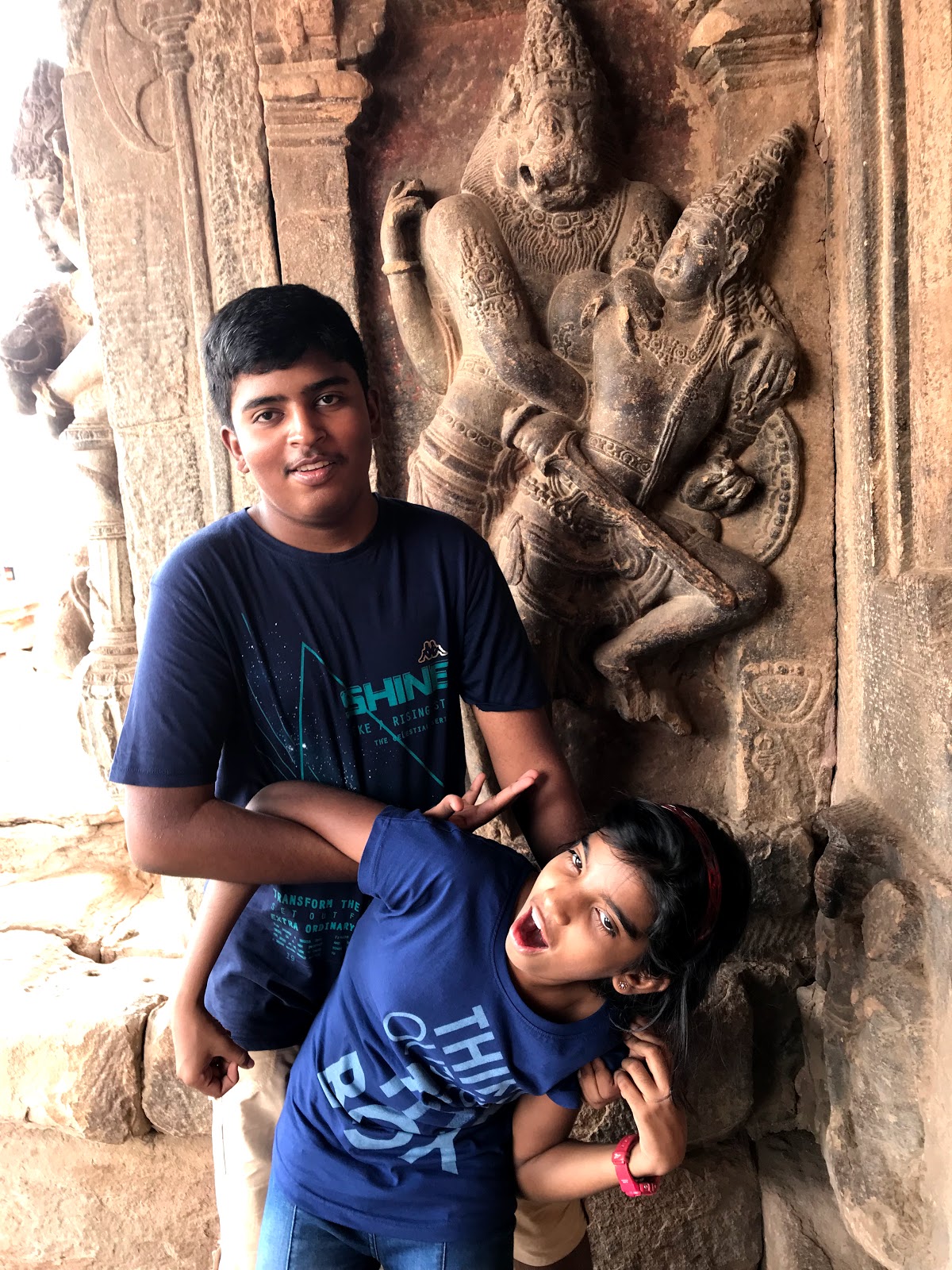
Kids posing like the Ukra narasimha behind
Vikramaditya II - probably the greatest Chalukya rulers since Pulikeshin II, and his queens contribute to most of the temples in Pattadakal and it must've been time of the area at the zenith of its glory. The complex also has a partial victory pillar of him - extolling his various conquests and victories over the Pallavas.
The Victory pillar
After walking around for a couple of hours, it was already time past lunch and so we decided to go to have some lunch and reach our next destination - in search of an inscription.

Hampi Chronicles - 2 - A Chalukyan Interlude

The next day, we took a leap back into history and went in search of history, a further 1000 years older than the one at Hampi,  moving away from the Tungabadra to the reaches of Krishna, in search of the architectural splendors of another great dynasty.
The Chalukyas, during their time of glory, had to vie for the control of their lands from North as well as from the South. They have to contend with two of the greatest kingdoms from these places and build themselves a home in the midst. The threat from North, they defeated and their tryst with the Pallavas in the south was stuff of legends and went on for a couple of hundred years.
Apsidal Durga temple
That alone is reason enough to travel another 150 kms in hot weather to reach their center of power. However, the Chalukyas were also great builders and most of what they built stands in the banks of River Malaprabha, in the middle of nowhere in today's India, telling stories of their valor and artistic might.
The road from Kamalapur to Aihole, our first destination, is a national highway and was very good to drive on, with tiny villages and some greenery along the Tungabadra canal ways. However, the land becomes more arid and dusty as we move away from the river and looks very impoverished in outlook. The villages themselves, were looking bare with no vegetation and there are a few schools and hardly any colleges to be seen. I desperately wanted to find at least one college, just to make myself feel better, but couldn't. All I could think was, may be there is one in the towns nearby.

Varaha - The Royal Emblem of Chalukyas is seen everywhere
Aihole, the capital of early Chalukyas, lies today on the banks of River Malaprabha in the interior of Uttara Karnataka, looking every bit the same as the thousands of villages in India, except for the cordoned off temples in the middle of it.
 It is hard to believe that this village at some point in the sixth century BC, was the capital of the most powerful kingdom in this part of the world. All that remains of that glory is the group of temples in the middle of this village and the temples strewn around the hill side.  There are multiple clusters of temples all around the main ASI monuments area and some of right in the middle of the huts , some are fenced off, some are left to rot. And the hillocks around have fort walls built around with the Meguti hill with the famous Jain temple atop lies on one side.
 It is kind of overwhelming to be in the midst of this group of temples and awestruck is just a word here. In a way, it also shows the extent of Aihole at the height of its glory. Although touted as the capital of early Chalukyas, this looks more of an artisanal playground for the Chalukyan stone masons and engineers in the experiments they've made, in building the temples in the complex.
A familial scene in the Durga temple - Loved it
The unusual apsidal Durga temple - which is not a Durga temple - is the quintessential symbol of Aihole and rightly so. It stands in the entrance of the complex and probably has been built at the zenith of the excellence of its period. The small temple is rich in sculptures and the vimana in the Nagara style in a raised plinth, evokes a feeling of wow immediately. The hall in the front, resembling the grand Chaityas of Buddhist viharas and the sculptures around along with sculptured pillars complete an architectural wonder which is to be seen in a life time.

There are multiple temples in this area, mostly looking like architectural experiments in that each has something very individualistic about it. The logs on the roof, the pillars which seems to be predecessor to the later Hoysala pillars of Belur, the very distinctive fusion of Nagara and Dravida style vimanas etc are something to be seen. The raised plinth actually brings out the beauty of the temple - which is again being taken to perfection by the Hoysalas in Belur . 

 The sculptures clearly show the transition from the North Indian to a unique Chalukyan style with influences from the Buddhist, Jaina traditions of the time. It is worthwhile to note that Pulikeshin II was a Jain and the Chalukyas were of mixed religious identities as well. Hence the influences from the caves of Ellora/Ajantha can be seen clearly as well. As much as the influences on the architecture here, I could also see a lot of trading of styles between the Chalukya - Pallava temples, especially in the sculptures. It is difficult to see them without being reminded of the same in the Pallava temples or in the later Chola temples. It will be a big debate to identify who was influencing whom- but I would say there was a lot of people moving between these sites working in multiple temples bringing in their expertise and creativity. 

Aihole, to do justify to all the details and temples, need a couple of days to see it in full. We had about a couple of hours. So it was in the other places we visited that day as well. So we started off to the next destination - the coronation center of the Chalukyas.

The Discovery and Conquest of Peru - Zarate.

பழைய புத்தக விற்பனையின் போது இந்தப்புத்தகத்தை வாங்கினேன். 1528ம் வருடம் ஸ்பானிய வீரர்கள், இன்றைய பனாமாவின் பசிபிக் கடற்கரைகளில் இருந்து தெற...