George Michell, the famous historian and architect, in his interesting article , talks about visiting Pattadakal from Aihole in the
1960s. There were no roads and he has to walk along the River
Malaprabha and wade in the water at the end of that arduous trek to
reach Pattadakal at that time.
And it is no better
today. The road from Aihole, if it can be called that, is nothing but
gravel and there are patches of motor-able road in between for few meters before it
transforms to gravel again. The route is through the mountains and
still impoverished villages and fields of corn in between.
However, what lies at the end of this 10 kms is worth that effort.
 |
| The complex at Pattadakal |
Pattadakal - the place where the Chalukyas crowned themselves as undisputed kings of their vast kingdom, is a big complex of multiple temples built a little later than Aihole but with a much more refined architecture and representing the culmination of the Chalukyan builders striving to achieve perfection.
 |
| Nagara Style |
There are still temples with both with the Nagara style and Dravidan styles in it - telling us that that question was never settled. But the place is full of temples - big and small - and inscriptions in Kannada, Sanskrit and probably Telugu as well. The place needs a lot of time to really go through each and every part of it.
 |
| What does this reminds of? |
River Malaprabha flows on one side with a very visible bend towards the North. It is not impossible to imagine the Chalukyan royals floating down in yachts for their coronations or for visiting the temples. However, it takes a very fertile mind to think that in the mid day sun surrounded by stone structures emitting heat.
Pattadakal has many striking temples and sculptures. But what struck me most was the twin temples of Virupaksha and Mallikarjuna. Both were built by the twin queens of the Chalukya king Vikramaditya II. I was trying to place why that temple looked familiar and realized much later that it resembled the Kailasanatha temple at Kanchi. It is proof again the influences of art between the Chalukyas and the Pallavas.
 |
| The Chalukya and the Pallava Shiva - check the similarity in execution |
Not just that, while walking around, came across the sculpture of the stylish Shiva. Strikingly similar to the one in the Vaikunta Perumal temple and Kailasanatha temple in Kanchi, it is stylish in its own way and has some subtle differences in execution but is proof enough that there was a lot of exchange of ideas and execution between the Chalukyas and Pallavas. I would even dare to conjecture that there may have been common sculptors working in both places.
 |
| The Chalukya (left), Pallava (Right below) and the Chola (right above) - The continuity of a tradition |
The other sculpture which has a continuity from Chalukyas is the Lingothbavar. The style of showing Shiva as a Lingam while Brahma and Vishnu search for the top of His head and Vishnu as Varaha digging to find His feet is a common sculpture in all the Chola temples and I've seen the same in Kanchi as well in the Pallava temples. And finding one in this complex is thrilling. It is the way of representation of Lingothbavar that is similar and seems like this thought has pervaded the sculptures from the 6-7th century AD of the Chalukya-Pallava period till the 11th century Cholas. The continuity of this way of representation says a lot about the tradition of the architecting in those days in the Southern India.
 |
| Couples - We had fun posing like the sculptures! |
 |
| Scenes from Mahabharatha |
Apart from these, the temples were actually a big art gallery. Every pillar and nook and corner of the temples are filled with friezes of scenes from the Ramayana and Mahabharatha. And of course, as in any other temple, there are scenes of amorous couples abound in the mandapas as well. It was interesting to see the various poses stricken by them and the headdresses, ornaments and the way they were making the stances.
 |
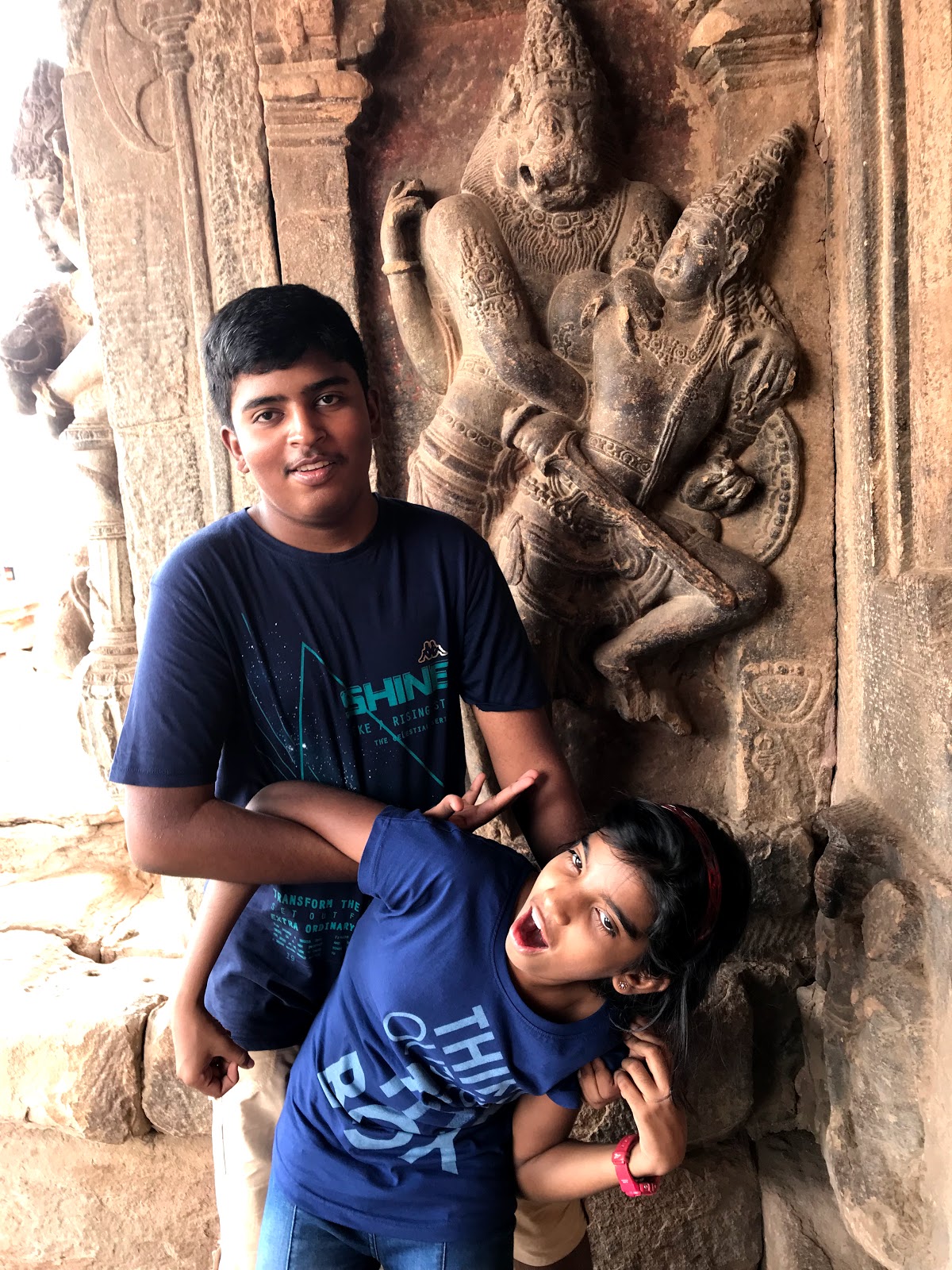
| Kids posing like the Ukra narasimha behind |
Vikramaditya II - probably the greatest Chalukya rulers since Pulikeshin II, and his queens contribute to most of the temples in Pattadakal and it must've been time of the area at the zenith of its glory. The complex also has a partial victory pillar of him - extolling his various conquests and victories over the Pallavas.
 |
| The Victory pillar |
After walking around for a couple of hours, it was already time past lunch and so we decided to go to have some lunch and reach our next destination - in search of an inscription.
 Pattadakal has many striking temples and sculptures. But what struck me most was the twin temples of Virupaksha and Mallikarjuna. Both were built by the twin queens of the Chalukya king Vikramaditya II. I was trying to place why that temple looked familiar and realized much later that it resembled the Kailasanatha temple at Kanchi. It is proof again the influences of art between the Chalukyas and the Pallavas.
 Vikramaditya II - probably the greatest Chalukya rulers since Pulikeshin II, and his queens contribute to most of the temples in Pattadakal and it must've been time of the area at the zenith of its glory. The complex also has a partial victory pillar of him - extolling his various conquests and victories over the Pallavas.