Showing posts with label Hampi. Show all posts

Hampi Chronicles 5 - The glory of ruins

After that day-long excitement amidst the glory of the Chalukyas, we decided to take it a little lighter the next day and decided to go roam around the Hampi island across the river. The plan is not to go look for any ruins but just get some ride and roam around the island.
Virupaksha temple from the Hampi Island
Hampi island is the hippie part of the town (village?) and it just lies across the river along the ruins of Hampi. The river can be crossed at multiple points but the active one - especially in the summer, when the water is low is at the Tungabadra ghats near the Virupaksha temple.
The Fields of Hampi Island
We took a coracle for the fun of it to get to the other side. April is almost summer and it is off-season in Hampi. So most of the shops catering to the 'hippie' crowds of foreigners in the island were either closed or almost empty. There are a bunch of places to stay and cafes - a la Mahabalipuram - and we rented a couple of scooters to go around. There is no petrol pump nearby and so you are stuck with buying petrol from the rental itself.
Riding around the island
As always, we took the wrong turn and ended in a dead-end road. So took the road back and managed to get to the main road. Again, the roads are pretty bad all along - gravels, pot holes and what not - with some tar showing up to remind you that you are in a road. We just rode along a few kilometers on either side and decided not to climb to see the Hanuman temple and decided to loiter around the rich fields of paddy, banana trees etc. After 2 hours of roaming the roads -with plenty of liquids in between - returned the scooters and returned to the hotel for lunch.
Vittala Temple
It was back to the ruins after lunch and went to the Vijaya Vitthala temple. Built in the traditional Dravidian style, the temple is probably the one place you should not miss in Hampi. The temple , though small in size - compared to the other elaborate ones - is basically a beauty in terms of the sculptural elegance in it and the architectural nuances in the stones that are all around to be seen.
The main part of the temple was closed for renovation work that was going on but all the mandapas can be seen. We engaged a guide and he had the usual stories to tell about the temple. But the temple has a charm with its partial gopuram and the beautiful stone chariot - Krishna devaraya's doing. However, compared to the elegance of the Hoysala temples and the Chalukyan ones we saw the previous day, the Vittala temple - at least, architecturally - seems a little underwhelming.
The dancing girls in the walls of the temple
The other reason might be the condition of the temple itself - it seems to be in a state of perpetual collapse. There is all kind of support structures - in the mandapas, the main temple and all around. Just keeping it going in itself seems a challenging one after the ruins from which, the current temple has been (re-)built. However, compared to how they looked - in Alexander Greenlaw's photographs from the 19th century - it is a remarkable job done by ASI in conserving this much of heritage for us to see.
Kings Balance
The Kalyana mandapa and the Uthsava mandapas are complete and are standing with some support. The elation of seeing a fantastic piece of art comes in the moment you enter the complex and doesn't really go away. The King's balance, where the king performed Tula bhara, stands mutely outside the complex, framing the boulders and hills as time passes by.
Royal Enclosure


The step wells
After stopping at a couple of places and finding that the Queen's bath is closed, our next stop was the Royal enclosure. What used to be the elaborate palaces and housing for the Royal family, there is not much left of any of the buildings other than the foundation stones and a few sculptures. But the extent of the enclosure just shows the amount of wealth that must've been here.
The dancing girls in the enclosure
The step wells and the aqua duct system to bring water from the river to the enclosures also show the detailed planning and work that has been done here. Sadly, a lot of the information around is conjecture as the ruins has reached a point of dilapidation when they were picked up and restored to show a little of the glory that was the Vijayanagara empire.
Hazara Rama temple panels


Outer walls of the temple
The real surprise here is the Hazararama temple. Probably the most intact temple in the area - the temple is full of amazing sculptures which tell the story of Rama. Being near the Royal enclosure area, this must've been the Royal temple for occasions - the kings of Vijayanagara were staunch Vaishnavites - and the temple is abundant with sculptures and even the outer wall is full of it.

The next day started with a refreshing bath in the waters of Tungabadra. Few years ago, it was at Kudli - where the rivers Tunga and Badra meet - we fell in love with the river. Tungabadra has a gentleness to its flow and the waters look friendly. And at Hampi, the river with the hills all around cannot look any more majestic or beautiful. So it was to the river in the morning and spend more than an hour in the river. I would say, its probably a must-do if you are ever in Hampi.
Bathing in Tungabadra River
Queen's bath - has the look of the Deccani Sultanate influence in it - but looks abandoned with crumbling structure inside and scrawling graffiti all around.The place need to be saved from the tourists.
Queen's bath
After that we made a quick visit to the Pattabirama temple, which is a little out of the way and looks deserted in the middle of the day. The other two tourists who were leaving as we were entering excitedly told us about this underground passageway we should not miss out in the main temple. We promptly took the bait and got into that. It was just the inner prahara around the garba griha and since the temple has no deity, the place looks empty and dark. We took the round and went back to the hotel.
Pattabirama Temple
 The ASI museum in Kamalapura is a must visit - as it keeps most of the 'other' history of Vijayanagara - coins, utensils, armor, paintings, textiles, copper plates etc from that bygone era and the lack of power when we went there, left a lot to be desired. They don't have a power backup and the museum looks dark in the middle of the day. What I liked is a series of pictures from the excavations - the before and after pictures - which show most of the ruins before they were restored.
The sculptures on display outside the museum
What we saw in the 3 days in just a small piece of Hampi - which lies around 35 sq.kms around. There are many more interesting pieces of ruins which stand there, mute witnesses to history and life passing around, waiting to be explored. And with the promise to return some day in the future again to explore, we said bye this time.

Hampi Chronicles - 1 - A Crying Bride

It has been years since I've been planning a trip to Hampi. For some reason, the travel eluded me - until now. The inaccessibility of the place is one big reason. There is no direct train connection from Chennai, there are no airports nearby serviced from Chennai and the drive is too long to enjoy the pleasures of the place. And of course, the consideration to go somewhere the kids would like to go and many other reasons meant that it was always in the bottom of the bucket list.

So it was until this year, when we decided to visit - come what may. Of course, the exam dates, the summer classes for the kids and the yearly trips to Madurai and all meant a tiny window to go for a vacation and we did exactly that (although Sibi ended up losing the first day of class!).

The onward journey was nothing exciting - got a connection at Guntakal to go to Hosepeta. It is a small mining station with nothing to go for it and luckily we booked our stay in a village called Kamalapura near Hampi. Kamalapura is what you can call a village's village and there is a ASI museum and that's that.  But as an entry point into Hampi, it has its advantages.

Hampi, on the first look, is not very impressive. The mountains full of boulders and the ruins - here and there - look nothing out of the ordinary. However, knowing the history a little, it is easy to understand what it all meant a few hundreds of years back and the place enchants the moment you start walking around the ruins.

The ruins were the result of the desertion of the city by the Vijayanagara ruling class , once the war at Talikota was lost. The allied Sultan's armies took their time to reach the gates and plunder the city for six months ensuring that there never will be another such city in the same place. It is impossible not to think of the fate of Carthage when that story is told.

Day one, after the travel , we decided to visit just the Virupaksha temple and the surroundings. The weather was hot and keeping everyone hydrated was the major task in the 3-4 hours we spent.

Virupaksha temple, to say it mildly, was a huge disappointment. The old temple has been pretty much lost in the conservation efforts of the ASI and what is now passing for the Virupaksha temple has probably nothing to do with the one from the times of Vijayanagara.

What makes me mad is that, if the ASI thinks it can conserve the temples and ruins by giving them a new color and 'repairing' the sculptures, they should at least do it in an aesthetically sensible way. The yellow color of the Virupaksha temple towers is such that, the moment you see it, you are just revolted. The same travesty that has ruined the great Chola temples in Tirubuvanam is just happening again here. However, as we found out later, ASI is doing a better job at other places in Hampi.

So, the moment I saw the temple, all I wanted was to get out of the place. However, we saw a marriage party entering the temple and the marriage mandapa in the temple was quite beautifully decorated. So, we decided to watch the marriage a little to see how it is done here.

What was shocking though was that the bride was incessantly crying standing near the mandapa. Tears were flowing down the cheeks and there is no one else who seem to be bothered about it. The groom seem to be a middle-aged person and the lady, probably in her late teens. The initial thought was some kind of a local tradition for the bride to cry but that does not make any sense. We were intrigued and watched the ceremony with unease and left the place before the ceremonies were complete.

It was easy to be judgemental in that place but without knowing what was going on , it was difficult to be that as well. For the next 3 days in Hampi, we kept inquiring the auto drivers, the car drivers, the guides about this and everyone seems to be saying that it may be a second marriage for the guy or the bride may be genuinely unhappy with the match - there was no good reason we could find to feel good about it. It was something that lingers on even after the trip is done.


So after Virupaksha, we walked down the huge Hampi bazaar and saw the huge monolithic bull. By this time, the kids have rented a couple of bikes and in the middle of the day heat, were happily riding around the empty bazaar. It was something to imagine the bazaar filled with merchants selling various stuffs in its heyday. Again, the bazaar is being maintained badly with no care taken and at some places, it is on the verge of collapse.
 We took to the mountain seeing the directions to the Vitthala temple and saw the majestic Tungabadra flowing in between the mountains of boulders. When we tried to go near the water, this sweet old man warned us in Kannada that there was a death at the same place last week and not to get into the water. We thanked him and walked back.

After that 4 hours spent in the middle of the day in scorching sun, there was no energy left and we just took a stroll in the Kamalapura village - which was an euphemistic way of saying that we took a 10 minute walk. So after spending an hour in the hotel pool, the day ended.

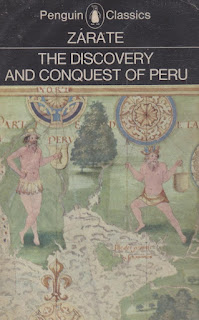
The Discovery and Conquest of Peru - Zarate.

பழைய புத்தக விற்பனையின் போது இந்தப்புத்தகத்தை வாங்கினேன். 1528ம் வருடம் ஸ்பானிய வீரர்கள், இன்றைய பனாமாவின் பசிபிக் கடற்கரைகளில் இருந்து தெற...