7 Days 7 Books - Book 3 - Love in the Time of Cholera

Reading books is an intensely personal exercise. One of the reason why many don’t like it. When you read the book the world outside stops and you are immersed in the world the book creates. A good book actually obliterates the line which separate the real world and the world it creates.

I don’t remember how I started on the Latin American literature. By habit, I read a book and find all the books I can around it’s central theme or author, and read more books around it. This has worked well in terms of exploring what I like in an much easier way. And there was a period where I took stock of the writers in all major languages in the world and came up with a list of authors to read. However, this list does not have Marquez at that time.

And the first book I read is 'One hundred years of solitude' and the world it introduced was just spectacular. The use the city of Macando as a character in the story was something I was mesmerized with. There was nothing like that I've read earlier. And my love affair with Gabriel Garcia Marquez started.

So it was that I ended up reading 'Love in the Time of Cholera'. It was such an unusual book. Just as the city becomes a character, here it is Love and Time which becomes a character of such intricacy and neatness. The love story starts - or continues - when the protagonists are actually in a very old age and goes towards an end through a series of flashbacks into the story of their lives.

The seductive nature of the story lies in its treatment of Love and the narration which itself feels like walking in and out of multiple dreams. The absurdity of a pure love, Ariza hears about the death of Urbino when he was lying naked with a prostitute and rushes of to profess his love to Fermina while she is preparing for the funeral of Urbino, her husband. What is pure here? The physical love or the more complicated spiritual love? The whole absurdity of this first chapter sets the tone for the rest of the book. 

Reductio ad absurdum is what explains love. When reduced to the basic logicality of expression, Love feels like absurdity. And this is what the book brings out brilliantly. As a love story, it cannot be more absurder than that - Ariza waiting in the wings for wooing Fermina again, while she completes a full life with her husband. And Ariza is not chaste in his waiting either, though he professes innocence to Fermina all along, he goes through a series of women like there is no tomorrow and there is no guarantee that he will stop that behavior when Fermina accepts him.

If all that, then what good is the book? The book works precisely because it brings out all that. There is no perfect love - as there are no perfect human beings - what we have only a broken life, where it is impossible to give anyone a perfect love, we make mistakes, fall mightily and try to rise, say or do the wrong thing again and again and yet the only thing that makes all that tolerable to live through is the love we have for the other. Without that tolerable entity to overlook the faults of one, it would be an impossible proposition to live a life of any magnitude. To me, that is the whole point of this book.

Ariza's faults are many - but he survives all that through the love he has for Fermina. Though it sounds cheesy to read that, the book works through the magical writing of Marquez and the witty humor that is spread all through the book. 

The movie version of the book - for those of you not patient enough to read - remains true to the book and is probably one of the best adaptions of film, I've seen. 

The book works for anyone who is a romantic at heart and still have a childish belief in Love being a cure for all the ills of life. There is nothing that can cure that kind of romanticism, of course and for those of us who are such, Marquez is a demi-god.

7 Days 7 Books - Book 2 - Crime and Punishment

My tryst with the Russian literature starts in my school days. 'NCBH - New Century book house' is a famous book shop (still is!) in Town hall road in Madurai, which also happened to be the distributor of the erstwhile Soviet publications of Raduka, Progress, Mir and many more. Many of which books are usually very cheap and used to be of very high quality. I still have most of the books I got from these days. So, it was through this that I got my introduction to Dostoevsky, Pushkin, Sholokov, Gogol, Turgenev, Chekov and of course, Tolstoy.

Except for Pushkin and Chekov, it was mostly reading way above my reading level. But I persisted. Names like Anoska, Natalya, Aksinia, Sofya,Masha use to mesmerize the mind. And a lot of my thinking evolved with these masters.

I must've read 'Crime and punishment' around this time. The date on the book says 1992 (I mark the books with the date I purchased them). And it must've been a drudging read as well. 

I picked up Dostoevsky - after the initial days - again during my first years in US. 'The brothers Karamazov', 'Demons', 'The Idiot' and 'White nights' were all read in quick succession and Dostoevsky , the prober of human souls became an all-time favorite.

The image that always comes to mind the moment I think of 'Crime and Punishment' is that of Raskolnikov, rushing off after murdering the old pawn broker, Alyona. I, somehow, formed an image of this scene and it always retains itself in mind.

It is probably the most vital moment of the story. Raskolnikov falls further in life from here and the moral quandary he finds himself in - becomes messier day by day. His love with Sofya, the prostitute, who teaches him the Christian virtues is another strange affair. Though fallen in the eyes of the society, Sonya is a much better human being than everyone around her and the conflict of values - personal vs the society - cannot be more in contrast.

Raskolnikov keeps dreaming of sequences - his soul is in torment of the murder and thievery he has committed - though the right way forward seems obvious, he has to struggle with himself to get to do the right thing. The terrible cost of doing the right thing is always in front of him, stopping him from doing it.

Dunya, his sister, who was ready to marry the wrong person for the sake of her family, comes in contrast with the values of Raskolnikov and at times, disgust him. His nihilistic view of the world is shaken by the values of the women around him - Dunya and Sofya.

Sofya tries to make him do the right thing - confess the crime but it is difficult for him to do. This personal struggle of being himself is the crux of the story.

'Crime and Punishment' still evokes a strong reaction when read. I found the morally flawed Raskolnikov to be a reflection of self and the torments he puts himself into was very familiar.  The hero is me. The book raises a lot of questions about the definition of the morality and the struggle to conform. 

Dunya was ready to marry for gain and considers herself to be making a sacrifice for the family. Raskolnikov feels disgusted at this and stop her from that madness. What is the moral stance for one here? what is the part of society that put Dunya in that position? - questions, questions and more questions - there are no simple answers here. 

This is the first book that had a deep psychological impact on me. It made me think, question and put to test all the beliefs, I've had. It made me look at the society's morality in disgust and norms as rotten. A lot of the conditions of the 19th century Russian society are still in force here and a lot worse still pervades the society. How do you figure the right from the wrong? Is it even binary?

7 Days 7 Books - Book 1 - Pride and Prejudice

I got tagged to share 7 book covers by a friend. I was not sure what is the point of just sharing book covers - so thought I would rather write about 7 books that made a difference for me in the next 7 days (and that depends a lot on the work schedule!!)

First, I am going to restrict myself to 7 English books and may be later, I might write about 7 Tamil books as well. And I have no set criteria or choice in choosing these books but these are the books that come to mind the moment I am asked to chose. So to the first book.

I read 'Pride and Prejudice' just when I finished college - in fact, most of these books are going to be from that period - when I was flush with money and had nothing else to do in life other than shopping in Amazon (yes, customer since 1998!) and Barnes and Noble, all the time.

And it was not the first Jane Austen book I read - that was 'Sense and Sensibility'. After watching that excellent movie version by Emma Thompson, I picked up the book and was hooked. When I found that Jane Austen has written only 6 or 7 novels in total, I went ahead and got all of them. 

What I loved in 'Pride and Prejudice' is that unending optimism of the story. While her other stories have strong heroines - there is a sense of disappointment and melancholy that pervades at places. You know that those girls are not entirely happy. But Lizzie is different. 

She is full of bonhomie and positive energy. There is nothing that will disappoint her or make her feel bad about herself. She always puts a positive spin on life and lived it. 

I used to wonder what would've happened if she did not end up marrying Darcy. The answer , to me, is that she would've married someone else and be that same girl she always was. Love is nothing but a part of life for her and would not have taken away her spirits.

That sets the tone for the entire story as well. There are no bad endings - even the wicked Wickham marries off (although whining!) and behaves in the end. Everyone ends up living, if not happily, at least rich, which is something. 

But why is it the top book in my list? because it is a romance and all romances are personal. The Lizzie - Darcy love story is not unique or the greatest in the world, but what makes it lovable is that the story is told as a product of their personalities and the events just happens around their personality. That is absolutely what is different from every other story out there. Lizzie does not change or lose her perspective anywhere in the story. Darcy - changes for the better - but is still the proud man we see at the Netherfield ball. And what they despised at the start becomes the one element that they fall in love with at the end. And that is wonderful to read about.

Probably, this is the book I've written more about than any other. And will write more but for now, that is the first book in the series. 

Astrophysics for People in a Hurry

Astrophysics for People in a HurryAstrophysics for People in a Hurry
My rating: 5 of 5 stars

Astrophysics - by any standards is a difficult subject to grasp. But it is not possible for anyone who, at some point contemplating our position in the universe to avoid reading anything about it. It used to be of such fascination to me during school days that I used to buy books like 'QED' - which I cannot even read , let alone understand.

However, it is this difficulty of comprehension that draws me again and again into it. The philosophical implications of reading Astrophysics aside, the challenge to comprehend the science is much more interesting. However, when one picks up a book like this, it is a tacit admittance that we are not gonna be looking at any equations or formula but looking for interesting information to brag.

That said, deGrasse Tyson's book is interesting and has the same tenor and simplicity of language which defined the other great master's - Carl Sagan- books. This, I do not say lightly, because Sagan is like the great teacher to me who through his many books taught me a lot about, not just Astrophysics but about all aspects of science.

This book is not an introduction - but some knowledge of physics is needed and moreover a curiosity to understand universe is a must. However, what I found going through it also is that though it seems like a light-read, it will take a lot of time to read through the host of terms and concepts from theoretical physics that will necessitate, additional reads as well.

That is what I found interesting - I kept looking up on terms and concepts and though it slows down the pace, it is probably the only way to read this book. That does not mean that the book goes over the mind - but just that it is so much interesting when you've a little of the background to relate.

I found the book to be very small - of course, the name is a giveaway - but there are lot of chapters I would've liked to be a little more detailed which would've made it much more interesting. May be he will write one , a little more detailed than this - for people like me who are not in such a hurry.

Overall, I found the book to be very interesting and if you're curious or have a kid who is curious, probably the best book today to get them.


Hampi Chronicles 5 - The glory of ruins

After that day-long excitement amidst the glory of the Chalukyas, we decided to take it a little lighter the next day and decided to go roam around the Hampi island across the river. The plan is not to go look for any ruins but just get some ride and roam around the island.
Virupaksha temple from the Hampi Island
Hampi island is the hippie part of the town (village?) and it just lies across the river along the ruins of Hampi. The river can be crossed at multiple points but the active one - especially in the summer, when the water is low is at the Tungabadra ghats near the Virupaksha temple.
The Fields of Hampi Island
We took a coracle for the fun of it to get to the other side. April is almost summer and it is off-season in Hampi. So most of the shops catering to the 'hippie' crowds of foreigners in the island were either closed or almost empty. There are a bunch of places to stay and cafes - a la Mahabalipuram - and we rented a couple of scooters to go around. There is no petrol pump nearby and so you are stuck with buying petrol from the rental itself.
Riding around the island
As always, we took the wrong turn and ended in a dead-end road. So took the road back and managed to get to the main road. Again, the roads are pretty bad all along - gravels, pot holes and what not - with some tar showing up to remind you that you are in a road. We just rode along a few kilometers on either side and decided not to climb to see the Hanuman temple and decided to loiter around the rich fields of paddy, banana trees etc. After 2 hours of roaming the roads -with plenty of liquids in between - returned the scooters and returned to the hotel for lunch.
Vittala Temple
It was back to the ruins after lunch and went to the Vijaya Vitthala temple. Built in the traditional Dravidian style, the temple is probably the one place you should not miss in Hampi. The temple , though small in size - compared to the other elaborate ones - is basically a beauty in terms of the sculptural elegance in it and the architectural nuances in the stones that are all around to be seen.
The main part of the temple was closed for renovation work that was going on but all the mandapas can be seen. We engaged a guide and he had the usual stories to tell about the temple. But the temple has a charm with its partial gopuram and the beautiful stone chariot - Krishna devaraya's doing. However, compared to the elegance of the Hoysala temples and the Chalukyan ones we saw the previous day, the Vittala temple - at least, architecturally - seems a little underwhelming.
The dancing girls in the walls of the temple
The other reason might be the condition of the temple itself - it seems to be in a state of perpetual collapse. There is all kind of support structures - in the mandapas, the main temple and all around. Just keeping it going in itself seems a challenging one after the ruins from which, the current temple has been (re-)built. However, compared to how they looked - in Alexander Greenlaw's photographs from the 19th century - it is a remarkable job done by ASI in conserving this much of heritage for us to see.
Kings Balance
The Kalyana mandapa and the Uthsava mandapas are complete and are standing with some support. The elation of seeing a fantastic piece of art comes in the moment you enter the complex and doesn't really go away. The King's balance, where the king performed Tula bhara, stands mutely outside the complex, framing the boulders and hills as time passes by.
Royal Enclosure


The step wells
After stopping at a couple of places and finding that the Queen's bath is closed, our next stop was the Royal enclosure. What used to be the elaborate palaces and housing for the Royal family, there is not much left of any of the buildings other than the foundation stones and a few sculptures. But the extent of the enclosure just shows the amount of wealth that must've been here.
The dancing girls in the enclosure
The step wells and the aqua duct system to bring water from the river to the enclosures also show the detailed planning and work that has been done here. Sadly, a lot of the information around is conjecture as the ruins has reached a point of dilapidation when they were picked up and restored to show a little of the glory that was the Vijayanagara empire.
Hazara Rama temple panels


Outer walls of the temple
The real surprise here is the Hazararama temple. Probably the most intact temple in the area - the temple is full of amazing sculptures which tell the story of Rama. Being near the Royal enclosure area, this must've been the Royal temple for occasions - the kings of Vijayanagara were staunch Vaishnavites - and the temple is abundant with sculptures and even the outer wall is full of it.

The next day started with a refreshing bath in the waters of Tungabadra. Few years ago, it was at Kudli - where the rivers Tunga and Badra meet - we fell in love with the river. Tungabadra has a gentleness to its flow and the waters look friendly. And at Hampi, the river with the hills all around cannot look any more majestic or beautiful. So it was to the river in the morning and spend more than an hour in the river. I would say, its probably a must-do if you are ever in Hampi.
Bathing in Tungabadra River
Queen's bath - has the look of the Deccani Sultanate influence in it - but looks abandoned with crumbling structure inside and scrawling graffiti all around.The place need to be saved from the tourists.
Queen's bath
After that we made a quick visit to the Pattabirama temple, which is a little out of the way and looks deserted in the middle of the day. The other two tourists who were leaving as we were entering excitedly told us about this underground passageway we should not miss out in the main temple. We promptly took the bait and got into that. It was just the inner prahara around the garba griha and since the temple has no deity, the place looks empty and dark. We took the round and went back to the hotel.
Pattabirama Temple
 The ASI museum in Kamalapura is a must visit - as it keeps most of the 'other' history of Vijayanagara - coins, utensils, armor, paintings, textiles, copper plates etc from that bygone era and the lack of power when we went there, left a lot to be desired. They don't have a power backup and the museum looks dark in the middle of the day. What I liked is a series of pictures from the excavations - the before and after pictures - which show most of the ruins before they were restored.
The sculptures on display outside the museum
What we saw in the 3 days in just a small piece of Hampi - which lies around 35 sq.kms around. There are many more interesting pieces of ruins which stand there, mute witnesses to history and life passing around, waiting to be explored. And with the promise to return some day in the future again to explore, we said bye this time.

Hampi Chronicles - 4 In search of an Inscription

Anyone who has read 'Sivagamiyin sabatham' needs no introduction to Badami - or the more familiar name Vathapi. The book is not my favorite piece of fiction or not even my favorite by Kalki. But I read it initially as a story and then at a later point realized that the story actually happened. It is one of my first introduction to the Pallavas and the fiction reading transformed into history reading and then actually visiting the places where these stories happened.
The hills of Badami - The caves can be seen
'Sivagamiyin sabatham' - in spite of the fact that the central figure in the drama, Sivagami, is a fictional character, gor a lot of things in relation to history correct. Kalki does not depict Pulikeshin II as a villain but rather someone at odds with himself. His expansionist ambitions versus his love for art is what plays out in the novel. Although I find the writing in this novel to be tedious, the history is wonderful.
View from the caves, the Agastya theertham and the temples on the other side
So it is how I was consumed by the wish to visit Vatapi at least once. Not only to see the erstwhile kingdom which challenged the Pallavas, but the artistic accomplishments of the Chalukyas itself. On that day, I already had seen Aihole and Pattadakal and needed no convincing about the accomplishments anyway.
Cave 1
I kept going back to the fact that these two emperors - Pulikeshin II and Narasimhavarman - traversed the entire landscape of the Deccan , with large armies, in hot weather and mind boggling logistics, to satisfy their vanity, under guises of revenge and expansion. It is difficult to do it in trains and cars these days.


Harihara Panel
The story of Pulikeshin II's attempt at capturing Kanchi during Mahendravarman's reign and the subsequent movement of Narasimhavarman to capture Vatapi and take revenge on Pulikeshin is well-known. The Pallavas - under Narasimhavarman and his able general, Paranjyoti - captured Vatapi and held it under occupation for 13 years, before Vikramatiya took it back. By that time, Narasimhavarman exits the stage and the Pallavas go into turmoil during the succession period. Vikramaditya takes his revenge by capturing Kanchi himself.
Varaha - Vishnu and the Royal emblem (Cave 2)
When the Pallavas held Vatapi, it is said that they erected a victory pillar and it was destroyed by Vikramatiya when he took over. The only remaining proof of this occupation is the inscription by Narasimhavarman in the rock surfaces back of the Mallikarjuna temple. This is what I wanted to see.
TriVikrama panel
Badami today is a small town with bad roads and still badly built houses and shops. The town was completely in grips of traffic chaos even in the middle of the day and is difficult to negotiate the lanes that lead to the main archeological centers of Badami, the Badami caves.
Ardhanarishwara panel
It is said that Pulikeshin II spent some time in the Ellora caves and came back to Vatapi, determined to replicate its splendor. The Badami caves, four in number, carved one above the other, have sculptures which again can compete with any other sculptures from the same time period and one can clearly see the continuity of the tradition from Ellora in all the caves.


Couple in love - Cave 3
What is also surprising is that this is the same period in the Pallava kingdom, where Mahendravarman and Narasimhavarman were busy with their cave temples. And the similarity between the ones in Badami and the Pallavas cave temples is again, astonishing. It is the only thing that kept coming into mind as we keep traveling into these areas. As much as the language and other differences exist between these areas, the similarities are as much as well.
Chaitya style hall - Cave 3
Of the 4 cave temples, one is Jain and the first three are Hindu. The sculptures and the Chaitya style halls in the caves are more elaborate. While the sculptures are exemplary, there is none that compares to the Mahishasuramardhini panel in Mahabalipuram. However, I would say, the size of the caves with the large halls cannot be compared to the smaller Pallava caves.
Parasvanath (Jain Tirthangara) - Cave 4
The caves also offer a panoramic view of the city below. The Agastya theertham pond and the temples that surround it looks like a different world from above in the hillocks. While we were there, the weather changed suddenly and after a spat of cold winds, it started drizzling and if there was heaven on Earth, it was that place at that time.
The 23 Tirthangara panel
So, it was off to find the Pallava inscription after the caves and we found that we have to walk around the Agastya theertham and there is no way the car can get into those by-lanes. By the time we started walking to the Mallikarjuna temple on the other side, the wind picked up and it slowly started raining. It was such fun to get wet and walk towards this picturesque place.
We reached the ASI museum near the Mallikarjuna temple and started inquiring about the location of this inscription. That's when we found that the inscription is in a rock boulder in the hillock near the museum and reaching it is going to involve climbing rocks and then as well, its gonna be difficult in the rain, that was picking up at that time. That also explained why I could not find a picture of this inscription in the net with all kind of searches. So, it was with disappointment that we left the place to visit the Mallikarjuna temple and the Bhootnatha temple. So it was that I decided to start searching for the inscription by Vikramaditya in the Kailasanatha temple in Kanchi.

Both the temples have a fantastically picturesque location and in that evening with dark clouds and incessant rain, they look like a places in a different world altogether. They are small temples with the Chalukyan sculptures and the Bhootnath temple has a distinct Dravidian style and the location jutting into the Agastya theertham look absolutely gorgeous.
Royal couple
The temples are not to be missed and we were told that there are hillocks all around full of smaller places of Jain and Chalukyan sculptures and there are small temples in the hills and the fort structures can be seen as well.


Bhootnath Temple
Badami/Vatapi , though seem like a little touristy place, it probably need 3-4 days to see in completion - especially along with Pattadakal and Aihole. I just wished we had more time to spend in these treasure trove of places to see and take it in full. 
The Dravida sigara - against the rain clouds
So it was after a very eventful day, in perfectly beautiful weather, we drove back to Hampi to continue the exploration of the place we left midway.

Hampi Chronicles 3 - The Coronation complex

George Michell, the famous historian and architect, in his interesting article , talks about visiting Pattadakal from Aihole in the 1960s. There were no roads and he has to walk along the River Malaprabha and wade in the water at the end of that arduous trek to reach Pattadakal at that time.

And it is no better today. The road from Aihole, if it can be called that, is nothing but gravel and there are patches of motor-able road in between for few meters before it transforms to gravel again. The route is through the mountains and still impoverished villages and fields of corn in between. 
However, what lies at the end of this 10 kms is worth that effort.
The complex at Pattadakal
Pattadakal - the place where the Chalukyas crowned themselves as undisputed kings of their vast kingdom, is a big complex of multiple temples built a little later than Aihole but with a much more refined architecture and representing the culmination of the Chalukyan builders striving to achieve perfection.
Nagara Style
There are still temples with both with the Nagara style and Dravidan styles in it - telling us that that question was never settled. But the place is full of temples - big and small - and inscriptions in Kannada, Sanskrit and probably Telugu as well. The place needs a lot of time to really go through each and every part of it.
What does this reminds of?
River Malaprabha flows on one side with a very visible bend towards the North. It is not impossible to imagine the Chalukyan royals floating down in yachts for their coronations or for visiting the temples. However, it takes a very fertile mind to think that in the mid day sun surrounded by stone structures emitting heat.


Pattadakal has many striking temples and sculptures. But what struck me most was the twin temples of Virupaksha and Mallikarjuna. Both were built by the twin queens of the Chalukya king Vikramaditya II. I was trying to place why that temple looked familiar and realized much later that it resembled the Kailasanatha temple at Kanchi. It is proof again the influences of art between the Chalukyas and the Pallavas.


The Chalukya and the Pallava Shiva - check the similarity in execution
Not just that, while walking around, came across the sculpture of the stylish Shiva. Strikingly similar to the one in the Vaikunta Perumal temple and Kailasanatha temple in Kanchi, it is stylish in its own way and has some subtle differences in execution but is proof enough that there was a lot of exchange of ideas and execution between the Chalukyas and Pallavas. I would even dare to conjecture that there may have been common sculptors working in both places.

The Chalukya (left), Pallava (Right below) and the Chola (right above) - The continuity of a tradition
The other sculpture which has a continuity from Chalukyas is the Lingothbavar. The style of showing Shiva as a Lingam while Brahma and Vishnu search for the top of His head and Vishnu as Varaha digging to find His feet is a common sculpture in all the Chola temples and I've seen the same in Kanchi as well in the Pallava temples. And finding one in this complex is thrilling. It is the way of representation of Lingothbavar that is similar and seems like this thought has pervaded the sculptures from the 6-7th century AD of the Chalukya-Pallava period till the 11th century Cholas. The continuity of this way of representation says a lot about the tradition of the architecting in those days in the Southern India.
Couples - We had fun posing like the sculptures!
Scenes from Mahabharatha
Apart from these, the temples were actually a big art gallery. Every pillar and nook and corner of the temples are filled with friezes of scenes from the Ramayana and Mahabharatha. And of course, as in any other temple, there are scenes of amorous couples abound in the mandapas as well. It was interesting to see the various poses stricken by them and the headdresses, ornaments and the way they were making the stances.


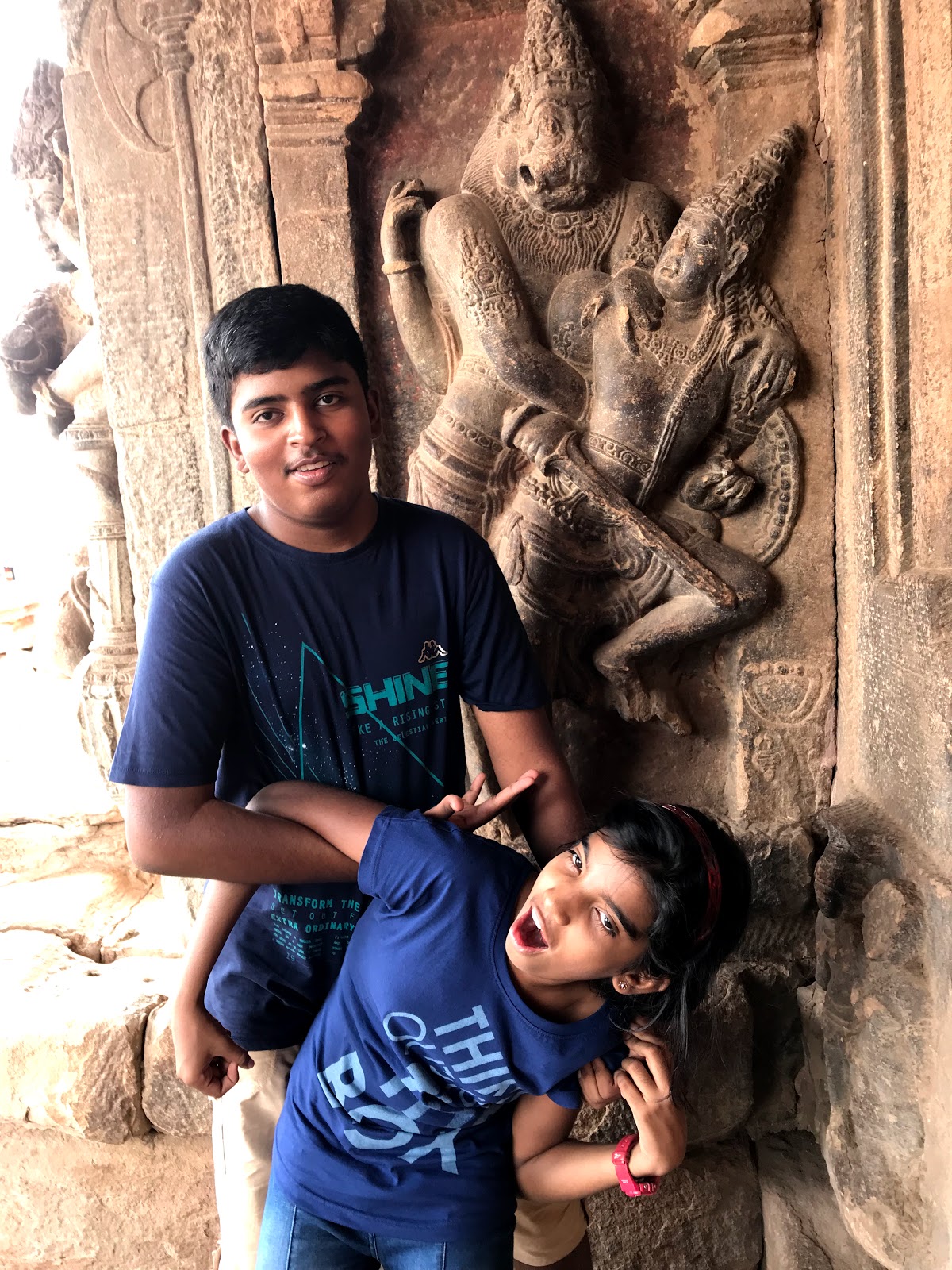
Kids posing like the Ukra narasimha behind
Vikramaditya II - probably the greatest Chalukya rulers since Pulikeshin II, and his queens contribute to most of the temples in Pattadakal and it must've been time of the area at the zenith of its glory. The complex also has a partial victory pillar of him - extolling his various conquests and victories over the Pallavas.
The Victory pillar
After walking around for a couple of hours, it was already time past lunch and so we decided to go to have some lunch and reach our next destination - in search of an inscription.

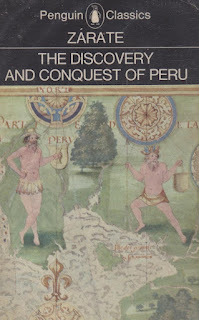
The Discovery and Conquest of Peru - Zarate.

பழைய புத்தக விற்பனையின் போது இந்தப்புத்தகத்தை வாங்கினேன். 1528ம் வருடம் ஸ்பானிய வீரர்கள், இன்றைய பனாமாவின் பசிபிக் கடற்கரைகளில் இருந்து தெற...