Showing posts with label Ron Chernow. Show all posts

Alexander Hamilton - Ron Chernow

Alexander HamiltonAlexander Hamilton by Ron Chernow
My rating: 4 of 5 stars

This completes the reading of all three of Ron Chernow's political biographies and I will surely miss his writing style - more of interesting narrative story-telling than the dry stating of facts. That said, reading this one took me three months - more because of the tardiness I developed towards reading than anything - I am still plodding through another biography of Pitt the Younger.

I came across Alexander Hamilton from reading Gore Vidal's 'Burr' about 13-14 years back. I've read about him a bit at a time and more as a side actor in the lives of Washington, Adams and Jefferson. So, I have to admit that I started this book with a lot of misgivings.

But I was glad that I took it up. I have read about Hamilton's setting up of the Bank of America and the financial institutions that built up the country, but not in this details. The story of a West Indian orphan making it into the bank notes of America is not just a remarkable story to read, it is inspiring as well.

Chernow goes into a lot of details about the early life of Hamilton in the slavery-ridden islands of the Caribbean and establishes a lot of context for the actions of Hamilton in the later parts of his public life. That also gives some context to some of his actions which seem inexplicable and sometimes, utterly self-destructing.

Hamilton comes out as a flawed genius - made his mark as the guy who created the Federal government as we know it today and then had to recede from politics with the rise of Jefferson and his party in the later days. His achievements in ensuring the finances of his country and in creating the institutions that sustain it are testimonial to his genius but the fact that politics never gave him another opportunity to influence the country's finances or anything is also sad.

He is also flawed because of the numerous mis-steps he make in his political career and which ultimately puts him outside the power corridor with the passing of George Washington. A lot of it can be attributed to his early days and the difficult path he has to take to reach the pinnacle of success. But that only is part of the story and a lot more can be said about the fatal flaws in the man's character itself which Chernow explores and at times, glosses over.

A biographer's job is difficult and he has to ensure that he is true to his subject. Chernow ,at times, gets enamored by his subject and starts passing judgement on his political opponents as if they were his own. Especially the rivalry between Hamilton and Jefferson need to be looked at in the context of the days and think both had the right intentions but developed different ways to attain it. Calling Jefferson's politics as Mobocracy only discredits the author and disservices the subject he has taken to defend.

The politics of the day - with Adams Vs Hamilton or Jefferson Vs Hamilton - was played dirty even by any other standards. Libelous writings were the norms of the day and the caricatures and the character assassinations through surrogate writers were shocking to modern sensibilities used to the fake news forwards in Whatsapp.

The Maria Reynolds affair is one at hand. Hamilton's affair with this lady is bad enough but the way it was hushed up - through black mails and gentlemen's honor etc only makes it worse. When there were anonymous writing (instigated by Jefferson, apparently) starts appearing in press, Hamilton responds by writing a salacious pamphlet of tens of pages accepting the same and putting every detail in paper. I couldn't comprehend the reason why he did it and apparently Chernow tries to find reasons which are too complex anyway.

"I heal all wounds but those which love hath made."- Hamilton

Eliza Hamilton and her relationship with Alexander comes out as more complex. He keeps putting her through impossible situations - like the Maria Reynolds affair or the later political turmoils in New York - and we do not have many documents or letters expressing how she felt about those and but going by her fierce loyalty to Hamilton's memory after his death, think she forgave him in most instances or her love was such that she was able see past his faults.

Finally, the Burr episode - which ends with the killing of Hamilton - is although understandable, is inexplicable. The whole episode escalates too fast and it is incredible that there is no one who try to deescalate the same thing and Hamilton, father of 8 children, is killed in the ensuing duel for some trifling reason - an apology would've been suffice. The gentlemen's code of honor and conduct of those days in at times irritatingly idiotic (although I say it with the full benefit of hindsight).

Over all, it is a very long book and I enjoyed it as most of the characters and the events of the period were of immense interest to me.

Washington - Ron Chernow

Washington: A LifeWashington: A Life by Ron Chernow


Thats two in a row - or almost in a row. After reading Chernow's 'Grant', wanted to follow it up with another one from him and ended up with 'Washington' and took me close to about a month and half to finish this one. I would have to say that I did not plod through - like I use to do with a lot of boring books. This one was interesting.

The interesting factor may be due to the fact that a lot of what I read was unknown to me and that always fascinates. While I've read a lot about the Revolutionary war and the presidency of Jefferson (thanks ,not in least, to Vidal's politically-charged 'Burr'), Washington, till this point remained that stony-face on the one dollar bill, serenely looking at you with absolutely no expressions, whatsoever.

So, it was interesting to read about the pre-revolutionary times - when he grew up in a family - visited regularly by untimely deaths of near and dears, which while unfortunate, inches him close to his destiny in a sure way, as Chernow keeps reminding while announcing every death.

While destiny may be an easy way out to explain how Washington ended up being the commander in chief of the Continental Army, the hard truth is that he is mostly a self-made man - who while trying to get free of an over-weening mother, makes a life for himself which makes sure that he is in the right places all the time, saying the right things and most importantly, doing the right things as well.

Unlike the other founding fathers of other countries I know of, Washington is not a overtly extrovert kind of person, who lead a revolution by rhetoric or through a spiritual influence or by sheer blood bath. He comes out unique, because of the way he conducts himself, there is no other way than to say, as a well-bred Southern Gentleman. That also does not account for that uniqueness as the other Virginians of the same time - Madison, Jefferson or others - are equally gentlemanly or more so than him. He comes out unique because he is a doer than a speaker or any of the other things. This is the most important aspect of his character which Chernow keeps emphasizing at every juncture of his life.

While I try to 'like' him while going through that monster of the book, he does not inspire a worship like Lincoln does or the charm which JFK brings. He does not want to be liked, I guess. He just silently wishes not to be disturbed and let him just do things. And the list of accomplishments , each a path-breaking precedent in its day, is long and that fact that he was chosen for each of these positions through acclamation creates a new kind of respect for him.

But what actually surprised me is the romantic in Washington. Of course, his marriage to Martha comes out more as a necessity than anything and they remain absolutely wonderful couple till the end. But his short lived love affair with Sally Fairfax has all the elements of that tragic love story that repeats through the ages and to think that he writes prose like this is absolutely fascinating to know.

"You have drawn me, my dear Madam, or rather I have drawn myself, into an honest confession of a Simple Fact. Misconstrue not my meaning, 'tis obvious; doubt it not or expose it. The world has no business to know the object of my love, declared in this manner to - you, when I want to conceal it. One thing above all things, in this World I wish to know, and only one person of your acquaintance can solve me that or guess my meaning - but adieu to this till happier times, if ever I shall see them. "


Of course, there are some grouses as well with the well-written book. For one, I don't think I wanted to know so much about Washington's teeth. I mean, at this point, I know more about his than I ever know about mine. I would've like to read more about the charged political environment of that initial days of the country and it was a dampener to slide over a lot of stuff that would've made some explosive prose. But then I may have to pick up the one on Hamilton for that, I guess.

Overall, a well written, absolute delightful book.

Grant - Ron Chernow

GrantGrant by Ron Chernow
My rating: 5 of 5 stars

I took to myself to read a biography of at least one president every year and 'Grant' by Ron Chernow is what I chose for this year. And I am glad that I did that.

The US Civil war has been a favorite obsession of mine for years now. For the simple reason that the good vs evil narrative here has no greys. The colossus of this war is undoubtedly, Abraham Lincoln. And it is easy to see why. The man has no vices, has a moral authority which is hard to question, the kindness of heart he exhibited and the resolution to fight till the end he showed are astonishing.

However, the Civil war also brought forth deeply flawed individuals with strong moral conviction to the fight against slavery. The foremost in this list Ulysses S. Grant. He is probably the greatest general in the history at that time and the strangely western charm he brings in is hard to resist.

I've read about Grant only in the context of Civil war and the much scandalized presidency of his two terms. So I approached the book with a trepidation that the book might make him fall from the high pedestal I've put up for him. But I finished the book with exactly the opposite feeling.

The first 40 years of Grant's life feels like a terrible Dickens novel. There is so much of misery going on in his life, it is actually a wonder that he was able to sustain his life till that point.


The main reason for that sustenance is probably his love for Julia - whom he married, much against the wishes of his abolition-loving family and Julia's slave holding family. He remains amazingly steadfast in his dedication to Julia and there is multiple instances throughout the book where incident after incident, Julia comes out as someone who actually saves and anchors Grant multiple times.

Apart from Julia, not much of good happens to him. Barring a brief stint in the Mexican war, Grant basically lives off the land , mostly without any money to go around, leaving Julia and the children with his father-in-law. He wanders, tries out multiple jobs - succeeds in none and develops a drinking problem.

The Civil war brings in the right opportunity for him to shine with his leadership and strategy. Along with William T.Sherman, he racks up a series of victories in the western front, which brings him to the notice of Lincoln, who makes him the General of the whole army. He promptly defeats the south, is stunned by the death of Lincoln and decides to run for the president after the disastrous tenure of Andrew Johnson.

Grant comes out of the book as a valiant soldier, a very good man - with a set of moral values which is hard to come by, with a naive believer in men who gets swindled off by his closest friends again and again through his entire life. This gullible nature seems to be ingrained in him so much that even in his last days, he is willing to be swindled by his publisher until Mark Twain talks him out of it.

The perfect moral compass of Grant is unquestionable - though he seem to have a knack for having rogues and swindlers around him all the time. His commitment to the abolition of slavery and reconstruction is unassailable. It must've felt terrible to fight the same foes on the ground and in the Hill throughout his life.

Overall, I would say the book was refreshing in its views of Grant and the amount of information (given the size of the book!) is staggering and I almost ended up reading about most of the battles of the Civil war along side the book for a better understanding.

A very interesting and informative book.

View all my reviews

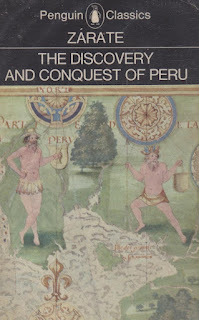
The Discovery and Conquest of Peru - Zarate.

பழைய புத்தக விற்பனையின் போது இந்தப்புத்தகத்தை வாங்கினேன். 1528ம் வருடம் ஸ்பானிய வீரர்கள், இன்றைய பனாமாவின் பசிபிக் கடற்கரைகளில் இருந்து தெற...